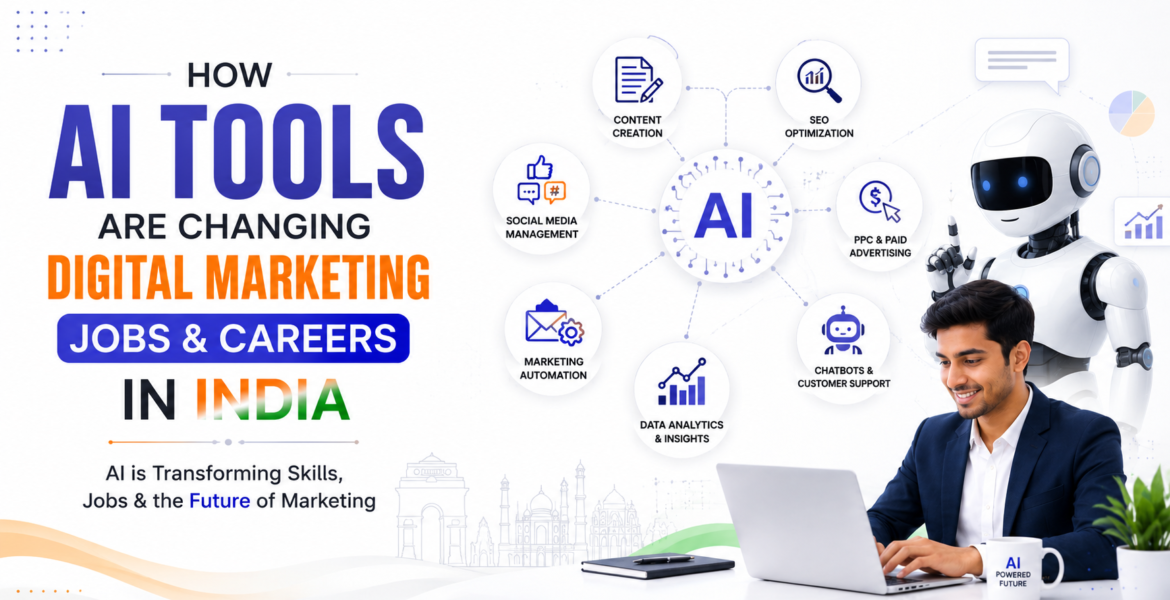
How AI Tools Are Changing Digital Marketing Jobs & Careers in India
Introduction
Imagine applying for a digital marketing job five years ago. Your resume listed skills like SEO, social media management, and Google Ads. Today, that same job posting reads: “Experience with AI tools preferred.”
That shift happened faster than anyone predicted and in India, it’s accelerating at a breathtaking pace.
AI tools in digital marketing are no longer a futuristic concept. They are live, active, and already reshaping how campaigns are planned, how content is written, and how brands connect with millions of customers online. From Mumbai startups to Bengaluru tech companies, AI-powered marketing is becoming the new normal.
Whether you’re a fresh graduate exploring career options or a working professional wondering if your job is safe, this article is your honest, practical guide to understanding what’s changing, what’s coming, and most importantly how you can stay ahead of the curve.
What Are AI Tools in Digital Marketing?
Before we dive into careers and opportunities, let’s get clear on what we’re actually talking about.
AI tools in digital marketing are software applications powered by artificial intelligence that help marketers plan smarter campaigns, create content faster, analyze data more accurately, and automate repetitive tasks all with minimal human effort.
These tools don’t replace your brain. They supercharge it.
Think of it this way: a good AI tool is like having a highly skilled assistant who never sleeps, never gets tired, and can process thousands of data points in seconds. That’s the edge it gives modern digital marketers.
AI for SEO
AI SEO tools like Semrush and Surfer SEO analyze search patterns, competitor rankings, and keyword opportunities far more efficiently than manual research. They suggest content structures, flag technical issues, and even predict what Google’s algorithm might reward next.
AI for Content Writing
Tools like ChatGPT and Jasper AI help marketers generate blog drafts, product descriptions, email sequences, and ad copies in minutes. The human marketer’s role shifts from writing every word to editing, refining, and adding brand voice which is actually a more strategic position.
AI for Social Media
Platforms like Buffer and Predis.ai use AI to suggest the best posting times, generate caption ideas, and even predict which content formats will perform best with a specific audience.
AI for PPC Advertising
Google’s Smart Bidding and Meta’s Advantage+ are AI-driven advertising systems that optimize ad delivery and budget allocation in real time. Marketers who understand how to work with these systems not just click buttons are commanding higher salaries.
AI Chatbots
AI chatbots on websites and WhatsApp handle thousands of customer queries simultaneously, qualify leads, and even close sales 24 hours a day. Building and managing these bots is now a valuable marketing skill in itself.
Why AI Is Growing Fast in India’s Marketing Industry
India is at a unique intersection of factors that make AI adoption in marketing not just likely but inevitable.
Internet growth is massive. India crossed 900 million internet users in 2024, making it one of the largest digital audiences in the world. Brands need to reach, engage, and convert this audience at scale and scale demands automation.
The startup ecosystem is booming. India is home to over 100 unicorns and thousands of funded startups. These companies move fast, operate lean teams, and adopt AI tools early because they simply can’t afford to do everything manually.
E-commerce is exploding. With Meesho, Flipkart, Myntra, and hundreds of D2C brands competing for attention, AI-driven personalization, dynamic pricing, and automated ad management have become table stakes not nice-to-haves.
Business automation demand is rising. From SMEs in Tier 2 cities to large enterprises in metros, Indian businesses are actively looking for marketers who can help them do more with less and AI is the tool that makes that possible.
The result? Companies across India are prioritizing candidates who understand AI-integrated marketing workflows, often offering salary premiums of 20–40% over candidates with traditional-only skill sets.
Top AI Tools Used by Digital Marketers in India
Here’s a practical look at the tools that are actively shaping the industry right now:
| Tool | Primary Use | Best For |
|---|---|---|
| ChatGPT | Content generation, research, strategy | Content marketers, SEO writers |
| Canva AI | Graphic design, presentations | Social media managers, designers |
| Semrush | SEO research, competitor analysis | SEO specialists, strategists |
| Jasper AI | Long-form content, ad copy | Copywriters, content teams |
| HubSpot AI | CRM, email automation, analytics | Marketing managers, agencies |
ChatGPT has become the Swiss Army knife of digital marketing. Marketers use it for everything from brainstorming campaign ideas to drafting client reports. In India, it’s particularly popular among freelancers who use it to scale their output without scaling their team size.
Canva AI has democratized graphic design in a country where professional design services can be expensive. Small businesses and solopreneurs now create professional-quality creatives with AI-assisted design suggestions, background removal, and Magic Write features.
Semrush is the gold standard for SEO professionals. Its AI-driven keyword research, site audit, and content optimization features help Indian agencies compete with global players on search rankings.
Jasper AI is widely used by content agencies handling multiple clients. It maintains brand voice consistency across large volumes of content something that’s nearly impossible to manage manually at scale.
HubSpot AI integrates customer data, automates email workflows, and surfaces actionable insights through predictive analytics. Marketing teams using it report saving 8–12 hours per week on manual reporting alone.
How AI Is Changing Digital Marketing Jobs
This is the question everyone is really asking and the honest answer is nuanced.
SEO careers are evolving, not disappearing. Manual keyword research spreadsheets are giving way to AI-powered tools that suggest entire content clusters. The modern SEO professional spends less time on data collection and more time on strategy, user intent analysis, and content quality oversight. It’s a more intellectually demanding role and a better-paid one.
Content writing jobs are seeing the most dramatic shift. Junior-level content farms that once employed dozens of writers churning out low-quality articles are struggling. At the same time, skilled content strategists who know how to prompt AI tools well, fact-check outputs, and add genuine expertise are thriving. The bar for what counts as “good content” has risen significantly.
Social media marketing roles are becoming more about community management, creative direction, and campaign strategy — while AI handles scheduling, A/B testing, and performance reporting. Social media managers who adapt are becoming more valuable; those who resist are finding the role shrinking.
PPC advertising has become a highly technical specialization. Google and Meta’s AI systems now handle a lot of the bid optimization automatically, which means PPC professionals need to focus on audience psychology, creative strategy, and interpreting machine learning signals skills that require genuine human judgment.
Graphic design workflows have been transformed by tools like Canva AI, Adobe Firefly, and Midjourney. Designers who use these tools as force multipliers are producing more output with better quality. Designers who see AI as a threat and avoid it are losing clients.
Video editing is being accelerated by tools like Runway ML and Pictory, which can auto-generate subtitles, remove silences, and even create video summaries from long-form content. For YouTube creators and brand video teams in India, this is a game-changer.
New Career Opportunities Created by AI in Marketing
Here’s something the headlines often miss: AI isn’t just changing existing jobs. It’s creating entirely new ones.
AI Marketing Specialist — professionals who design and implement AI-driven marketing strategies across channels. This role barely existed three years ago and is now listed in job postings at companies like Zomato, Razorpay, and Myntra.
Prompt Engineer (Marketing) — specialists who know how to write precise, effective prompts for AI tools to generate high-quality marketing outputs. In a world where “garbage in = garbage out” applies to AI, prompt engineering is a genuine competitive skill.
Marketing Automation Expert — professionals who build, manage, and optimize automated marketing workflows across email, WhatsApp, CRM, and ad platforms. Indian companies scaling rapidly need these specialists urgently.
AI Content Strategist — someone who plans content at a high level, uses AI tools to execute efficiently, and ensures content aligns with both SEO goals and brand narrative. This is arguably the hottest content role in the market right now.
Analytics Specialist — marketing data professionals who can interpret AI-generated reports, build dashboards, and translate data into actionable business decisions. As AI generates more data than ever, the ability to make sense of it is priceless.
These roles often pay between ₹6 LPA and ₹25 LPA depending on experience and company size — significantly above average marketing salaries in India.
Skills Needed to Succeed in AI-Powered Marketing
You don’t need an engineering degree to thrive in AI-powered digital marketing. But you do need the right combination of technical awareness and human creativity.
Prompt writing is the new keyword research. Knowing how to instruct AI tools to produce exactly what you need — in the right tone, format, and depth separates average users from power users.
Creativity remains irreplaceable. AI can generate a hundred variations of an ad headline, but it takes a human to recognize which one will genuinely resonate emotionally with a specific Indian audience during a festival campaign.
Data analysis skills are non-negotiable. Modern marketers need to understand what metrics matter, how to read AI-generated reports, and how to draw strategic conclusions from campaign data.
SEO fundamentals the core principles of search engine optimization aren’t going away. If anything, understanding why search engines work the way they do makes you a better user of AI SEO tools.
Strategic thinking is what separates a tool operator from a marketing professional. AI executes. Humans decide what to execute, why, and for whom.
AI tool expertise hands-on familiarity with the tools mentioned above, plus the curiosity to keep learning as new tools emerge every quarter.
Will AI Replace Digital Marketers?
Let’s be direct: AI will replace some digital marketing tasks. It will not replace thoughtful, skilled digital marketing professionals.
Here’s the distinction that matters.
AI is exceptional at repetitive, pattern-based work: generating first drafts, resizing images for different platforms, scheduling posts, running A/B tests, monitoring rankings, and sending automated emails. If your current job consists primarily of these tasks, yes AI will automate much of it.
But marketing at its core is a deeply human discipline. It’s about understanding desire, building trust, telling stories that move people, and making judgment calls in ambiguous situations. No AI tool currently available and none on the horizon can replace a marketer who deeply understands their audience and knows how to connect with them authentically.
The professionals who thrive will be those who embrace the “AI + Human” model: using AI to handle volume and speed while focusing their human energy on strategy, creativity, and relationship-building.
Brands that tried to go “100% AI” on their content have discovered this the hard way their content became bland, generic, and forgettable. The winning formula is always human insight, AI execution.
Benefits of Learning AI in Digital Marketing
For students and professionals in India, investing time in AI marketing skills pays off quickly and substantially.
Better salaries are the most immediate reward. Job portals like Naukri and LinkedIn consistently show that roles requiring AI tool knowledge command 25–40% higher compensation than equivalent roles without that requirement.
Faster career growth comes naturally when you can do in three hours what a traditional marketer does in three days. That kind of productivity makes you indispensable to any team or client.
Freelancing opportunities have expanded dramatically. Indian freelancers on platforms like Upwork and Toptal who offer AI-integrated services AI content strategy, automated lead generation, AI social media management are landing international clients at premium rates.
Increased productivity means you can take on more clients, produce more output, and grow your income without burning out. Many Indian freelancers report tripling their output after integrating AI tools into their workflow.
High industry demand ensures job security in a way that few other skill sets currently offer. As of 2025, LinkedIn reports that “AI literacy” is one of the fastest-growing skills listed on Indian marketing job postings.
How Students and Professionals Can Start Learning AI Marketing
The good news is that you don’t need years of study to get started. Here’s a practical roadmap:
Step 1: Take an AI-integrated digital marketing course. Look for programs that don’t just teach traditional marketing but actively incorporate AI tools into every module from SEO to content to paid advertising. Hands-on practice with real tools is non-negotiable.
Step 2: Practice tools daily. Open ChatGPT and write five different versions of an ad headline for a product you like. Use Canva AI to create a social media post. Use Semrush’s free tier to analyze a website. Daily practice builds intuition that courses alone can’t give you.
Step 3: Build a portfolio of AI-assisted projects. Run a mock campaign. Create a sample content calendar using AI tools. Optimize a blog post with Surfer SEO. Document your process. Employers want to see that you can use these tools, not just that you’ve heard of them.
Step 4: Stay updated with trends. AI moves fast. Follow industry publications like Search Engine Journal, Marketing AI Institute, and Neil Patel’s blog. Join Indian digital marketing communities on LinkedIn and Telegram where practitioners share real-world learnings.
Step 5: Earn recognized certifications. Google, HubSpot, Semrush, and several Indian training institutes now offer certifications that specifically recognize AI marketing competencies. These add credibility to your resume and LinkedIn profile.
Conclusion
The story of AI in Indian digital marketing isn’t one of replacement it’s one of transformation.
The marketers who are thriving right now are not the ones who resisted AI out of fear. They’re the ones who got curious, got trained, and got to work. They’re using AI tools to do better work, serve more clients, earn higher salaries, and build more resilient careers.
India’s digital economy is growing at a pace that demands exactly this kind of adaptable, AI-empowered marketing professional. If you’re ready to become one, the right place to start is with a structured, industry-aligned program like MDMI Digital Marketing Institute where AI-integrated training is built into every module, not just mentioned as an afterthought.
The opportunity is real, it’s large, and it’s available to anyone willing to invest in the right skills.The only wrong move is to stand still.
Frequently Ask Questions
AI is used in digital marketing across multiple functions including SEO research, content generation, social media scheduling, paid ad optimization, customer chatbots, email automation, and performance analytics. AI tools help marketers work faster, personalize campaigns at scale, and make data-driven decisions more efficiently.
AI will automate repetitive marketing tasks, but it will not replace skilled digital marketers. Human creativity, strategic thinking, emotional intelligence, and brand judgment remain irreplaceable. The future belongs to marketers who know how to work with AI not those who compete against it.
The most widely used AI tools for digital marketing include ChatGPT (content and strategy), Semrush (SEO), Jasper AI (copywriting), Canva AI (design), HubSpot AI (CRM and automation), and Google's AI-powered ad tools (Performance Max, Smart Bidding). The right tool depends on your specific marketing function.
Yes strongly so. Indian companies across industries are actively seeking AI-literate marketing professionals. Roles that combine traditional digital marketing skills with AI tool expertise consistently command higher salaries, better growth opportunities, and stronger job security compared to traditional-only marketing roles.
Key skills for AI marketing careers include prompt engineering, SEO fundamentals, data analysis, creative strategy, proficiency with AI tools (ChatGPT, Semrush, Jasper, etc.), and the ability to interpret campaign analytics. Strong communication and critical thinking remain foundational to everything.
