
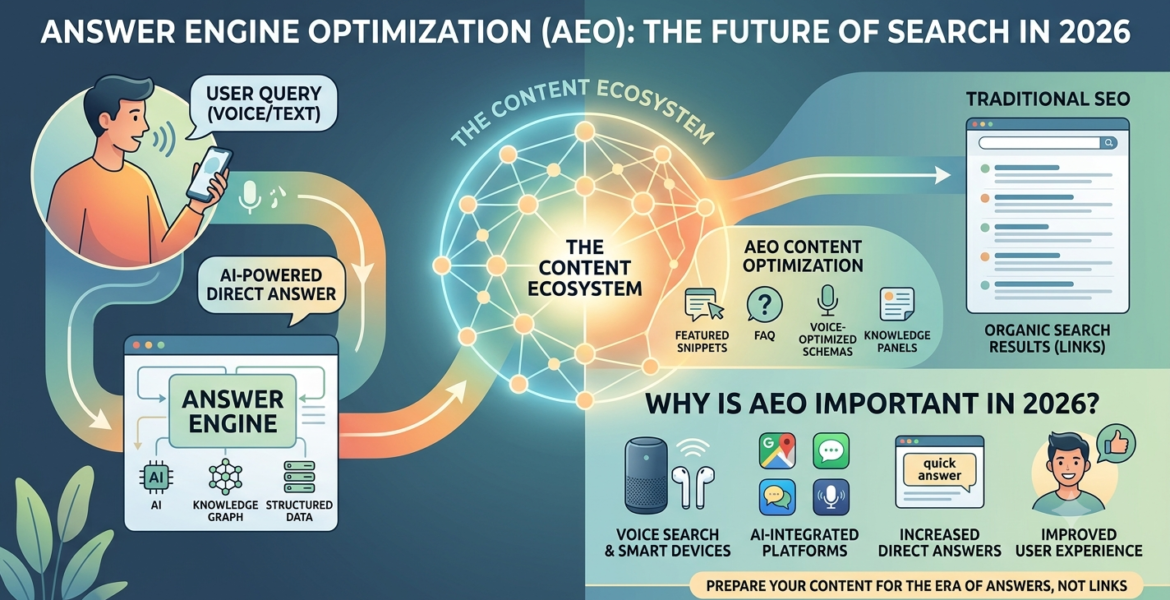
What Is Answer Engine Optimization (AEO) and Why Is It Important in 2026?
The last time you asked Google a question, did you get a straight answer right at the top, no clicking involved? Or perhaps you chatted with ChatGPT, which spits out full, confident responses with no links needed. That’s an answer engine doing its thing.
The way people search has shifted. We no longer type keywords and hunt through ten blue links. We ask full questions and expect instant answers. This shift is quietly rewiring the entire SEO industry and if you’re not paying attention, your content is already being left behind.
This is where Answer Engine Optimization (AEO) comes in. In this article, you’ll learn what AEO is, why it matters in 2026, and how to apply it to your content so AI assistants and search engines start recommending you.
What Is Answer Engine Optimization (AEO)?
AEO is the process of structuring your content so it gets picked up and cited by answer engines tools like Google’s AI Overviews, ChatGPT, Perplexity, Gemini, Siri, and Alexa as the best response to a user’s question.
Unlike traditional SEO, which focuses on ranking in a list of search results, AEO focuses on becoming the answer itself.
Real-world example: Someone asks Google: “What is the best time to post on Instagram in India?” Google’s AI Overview pulls one crisp answer from one source and displays it at the very top. That website gets featured even if it’s not ranking #1 in regular results. That’s AEO in action.
How Does AEO Work?
Answer engines use a combination of signals to decide whose content to feature:
-
- Natural Language Processing (NLP) — understands the intent behind a question
-
- Structured data and schema markup — reads your content programmatically
-
- E-E-A-T signals — judges trustworthiness and authority
-
- Content clarity and format — extracts clean, accurate answers
-
- Entity recognition — understands what your content is about
When you optimize for AEO, you make your content easy for machines to read, trust, and repeat.
Key Benefits of AEO
| Benefit | What It Means |
|---|---|
| Zero-click visibility | Your brand gets seen even without a site visit |
| Voice search dominance | Voice assistants rely on answer-engine logic |
| Higher credibility | Being cited by AI tools builds brand authority |
| Future-proof content | AEO value grows as AI search expands |
| Multi-platform reach | Visibility across Google, ChatGPT, Perplexity, Gemini |
Common Problems and Solutions
Problem 1: Content Isn’t Structured for Direct Answers
Most content is written for human readers who scroll not for AI engines that need a clean answer in the first paragraph. If you bury your answer 400 words deep, AI engines skip it entirely.
Solution: Open every major section with a direct question as a subheading, then answer it immediately in 40–60 clear words before expanding with examples and detail.
Pro Tip: Use Google’s People Also Ask section as a goldmine for AEO-ready questions. Every PAA question is a potential subheading.
Problem 2: Missing Schema Markup
Many websites have no structured data at all or use it incorrectly. Schema markup is one of the primary signals answer engines use to verify and categorize content.
Solution: Add FAQPage JSON-LD schema to every article with a Q&A section. Use Article schema to tell Google who wrote it and when.
Pro Tip: Use Google’s Rich Results Test to validate your schema before publishing. Invalid schema can trigger manual review flags.
Problem 3: Weak E-E-A-T Signals
AI engines are trained to prioritize trustworthy, authoritative content. Generic, thinly written articles almost never get pulled into AI-generated answers especially in finance, health, or education niches.
Solution: Add author bios with credentials, link to primary sources, cite statistics with sources, and include real-world examples. E-E-A-T is about the entire trust ecosystem around your brand.
Pro Tip: Always include a named author with real credentials. Anonymous content has near-zero chance of being cited by AI engines in high-trust niches.
Problem 4: Ignoring Conversational Keywords
Traditional SEO targets short keywords. But answer engines process full natural-language questions like “What is the difference between AEO and SEO?” not just “AEO SEO.”
Solution: Use tools like AnswerThePublic and AlsoAsked to find conversational, long-tail question phrases. Write content that mirrors how your audience actually speaks.
Pro Tip: Test your target queries directly in ChatGPT, Gemini, and Perplexity. If your content isn’t being cited, study what is being cited that’s your benchmark.
Conclusion
The way people find information has changed and it’s not going back. Answer engines are here to stay, and they’re getting smarter every month.
The key takeaway is simple: if your content can’t be understood, trusted, and repeated by an AI engine, it will gradually become invisible no matter how strong your traditional SEO is.
AEO isn’t a replacement for SEO. It’s its natural evolution. Brands that embrace this shift now writing direct answers, implementing schema, and building E-E-A-T will dominate both human and AI-driven search in 2026 and beyond.
Start today: Pick your top five blog posts, add FAQ schema to each, and rewrite introductions to lead with a direct, quotable answer. That’s your first real step into AEO.
Answer Engine Optimization (AEO) is the practice of structuring and optimizing content so it can be directly picked up by search engines and AI systems as clear answers. In 2026, it plays a key role in improving online visibility, increasing organic traffic, and building strong digital authority in AI-driven search results. To explore more about modern SEO and digital strategies, visit MDMI.
Frequently Ask Questions
AEO is the process of optimizing your content so AI tools like Gemini, ChatGPT, and Google AI Overviews can directly pick it as an answer. Instead of ranking pages like traditional SEO, AEO focuses on becoming the exact response users see when they ask a question. It relies on clear structure, direct answers, and strong authority signals so AI systems can easily understand and reuse your content.
Gemini uses context understanding, entity recognition, and trust signals from Google’s index. It prefers content that is well-structured, fact-based, and written in a question-answer format. Pages that clearly define concepts, use schema markup, and demonstrate E-E-A-T (Experience, Expertise, Authoritativeness, Trustworthiness) are more likely to be selected for AI-generated responses.
No, AEO is not replacing SEO it is expanding it. SEO still helps you rank in Google search results, while AEO helps your content get featured in AI-generated answers. In 2026, both work together. SEO brings visibility in search listings, and AEO ensures your content is used by AI systems like Gemini and Perplexity for direct answers.
Small businesses can rank in Gemini results by focusing on clarity, trust, and local relevance. They should:
- Write direct Q&A-based content
- Add FAQ schema and structured data
- Use local keywords (city-based intent)
- Build strong Google Business Profiles
Even small websites can appear in AI answers if their content is clear, useful, and better structured than larger competitors.
Gemini prefers complete, well-structured, and conversational content. It favors pages that fully explain a topic in one place, include FAQs, real examples, and use natural language. Content that is too short, keyword-stuffed, or unclear is less likely to be used in AI-generated answers. In short, Gemini prefers content that feels like a helpful expert explaining things simply.
